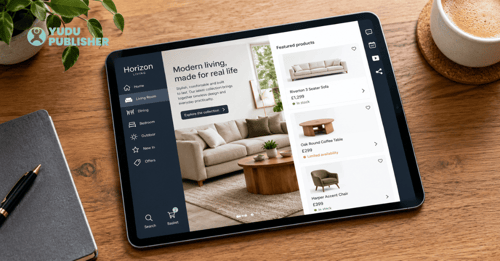
Your digital catalogue may be beautifully designed, fully interactive, and packed with compelling products - but before visitors can experience any of that, they need to take one crucial step.
They need to open it.
Many retailers focus heavily on optimising the catalogue itself, refining layouts, adding interactive elements, and improving product presentation. Yet the page that sits between your marketing campaigns and your catalogue often receives far less attention.
Whether you're driving traffic from email campaigns, social media, paid advertising, QR codes, SMS marketing, or organic search, the landing page is the gateway to catalogue engagement. Get it right, and more visitors will enter your catalogue ready to browse. Get it wrong, and potential customers may leave before seeing a single product.
Here are seven landing page optimisations that can help increase catalogue opens and ultimately drive more product clicks.
1. Make Your Value Proposition Instantly Clear
Visitors should understand within seconds why they should open your catalogue. One of the most common mistakes is relying on generic messaging such as:
"View Our Latest Catalogue"
While technically accurate, it doesn't tell visitors what they'll gain from opening it. Instead, focus on the value inside:
- Discover 300+ Summer Garden Essentials
- Browse This Week's Exclusive Home Improvement Deals
- Explore Our New Autumn Furniture Collection
- Find Special Offers Available Online and In Store
The goal is to answer three questions immediately:
- What is this catalogue?
- What's inside it?
- Why should I care?
A strong value proposition gives visitors a reason to click through and continue their journey.
2. Put the Catalogue Front and Centre
Your catalogue should be the hero of the page.
Too often, landing pages contain multiple competing messages, banners, promotions, and navigation options that distract visitors from the primary objective. Instead, make the catalogue itself the focal point.
Effective catalogue landing pages typically include:
- A large catalogue cover image
- A clear catalogue preview
- Supporting promotional messaging
- A prominent call-to-action button
Think of the catalogue cover as product packaging. It provides the first impression and can significantly influence whether visitors choose to engage.
A high-quality visual presentation helps visitors understand exactly what they're about to access.
3. Create a Single, Obvious Call to Action
The purpose of the landing page is simple: encourage visitors to enter the catalogue. That means your primary call to action should be impossible to miss.
Strong examples include:
- Open Catalogue
- Browse the Collection
- View Current Offers
- Explore Products
Avoid vague wording such as "Learn More" or "Continue."
The best-performing catalogue landing pages minimise decision-making. Visitors should immediately understand what action to take next.
Many marketers also benefit from repeating the call to action throughout the page, particularly on mobile devices where users may scroll before deciding to engage.
4. Give Visitors a Preview of What's Inside
Opening a catalogue represents a small commitment. Visitors are more likely to take that step when they know what they'll receive in return. A preview section can create curiosity and build anticipation.
Consider showcasing:
- Featured products
- New arrivals
- Best sellers
- Seasonal collections
- Limited-time offers
- Exclusive catalogue promotions
This doesn't require displaying dozens of products.
A carefully selected preview can provide enough incentive to encourage visitors to continue into the catalogue experience. Think of it as the trailer before the main feature.
5. Optimise for Mobile Users First
Many catalogue visits now begin on mobile devices.
A landing page that works perfectly on desktop but creates friction on mobile can significantly reduce engagement before users ever reach the catalogue.
Review your landing page experience on multiple devices and pay particular attention to:
- Page load speed
- Button size and placement
- Text readability
- Scroll behaviour
- Catalogue preview visibility
The journey from campaign click to catalogue open should feel effortless regardless of screen size.
Even small improvements to mobile usability can have a measurable impact on catalogue opens and downstream product engagement.
6. Build Confidence with Social Proof
Visitors are more likely to engage when they believe the content is valuable and trusted by others. Social proof can provide that reassurance.
Depending on your business, this might include:
- Customer testimonials
- Product review ratings
- Subscriber numbers
- Customer counts
- Industry awards
- Trust badges
For example:
"Trusted by over 500,000 customers each month."
Or:
"Our latest catalogue generated over 100,000 product views."
These signals help reduce uncertainty and encourage visitors to take the next step.
7. Measure What Happens Before the Catalogue Opens
Many organisations carefully analyse catalogue performance while overlooking the stage immediately before it. This creates a significant blind spot.
If visitors aren't opening the catalogue, improvements made inside the catalogue itself may never be seen.
To understand the full customer journey, track metrics such as:
- Landing page visits
- Call-to-action click-through rates
- Catalogue opens
- Bounce rates
- Traffic source performance
- Device performance
- Product click-through rates
By measuring both landing page performance and catalogue engagement, marketers gain a much clearer picture of where opportunities exist.
Sometimes the biggest improvement isn't redesigning the catalogue—it's simply helping more visitors reach it.
The Overlooked Stage of Catalogue Performance
When discussions around digital catalogue optimisation take place, attention naturally focuses on the catalogue experience itself.
Interactive content, product hotspots, videos, search functionality, and merchandising all play important roles. However, every successful catalogue engagement starts with a visitor deciding to open the catalogue in the first place.
That's why the landing page deserves just as much strategic attention as the catalogue it promotes.
By creating a clear value proposition, reducing distractions, providing compelling previews, and carefully measuring performance, marketers can increase catalogue opens and create more opportunities for product discovery.
Because before visitors can click products, they need a reason to click the catalogue.
.png?width=200&height=50&name=YUDU%20Publisher%20-%20Logo%20(1).png)